
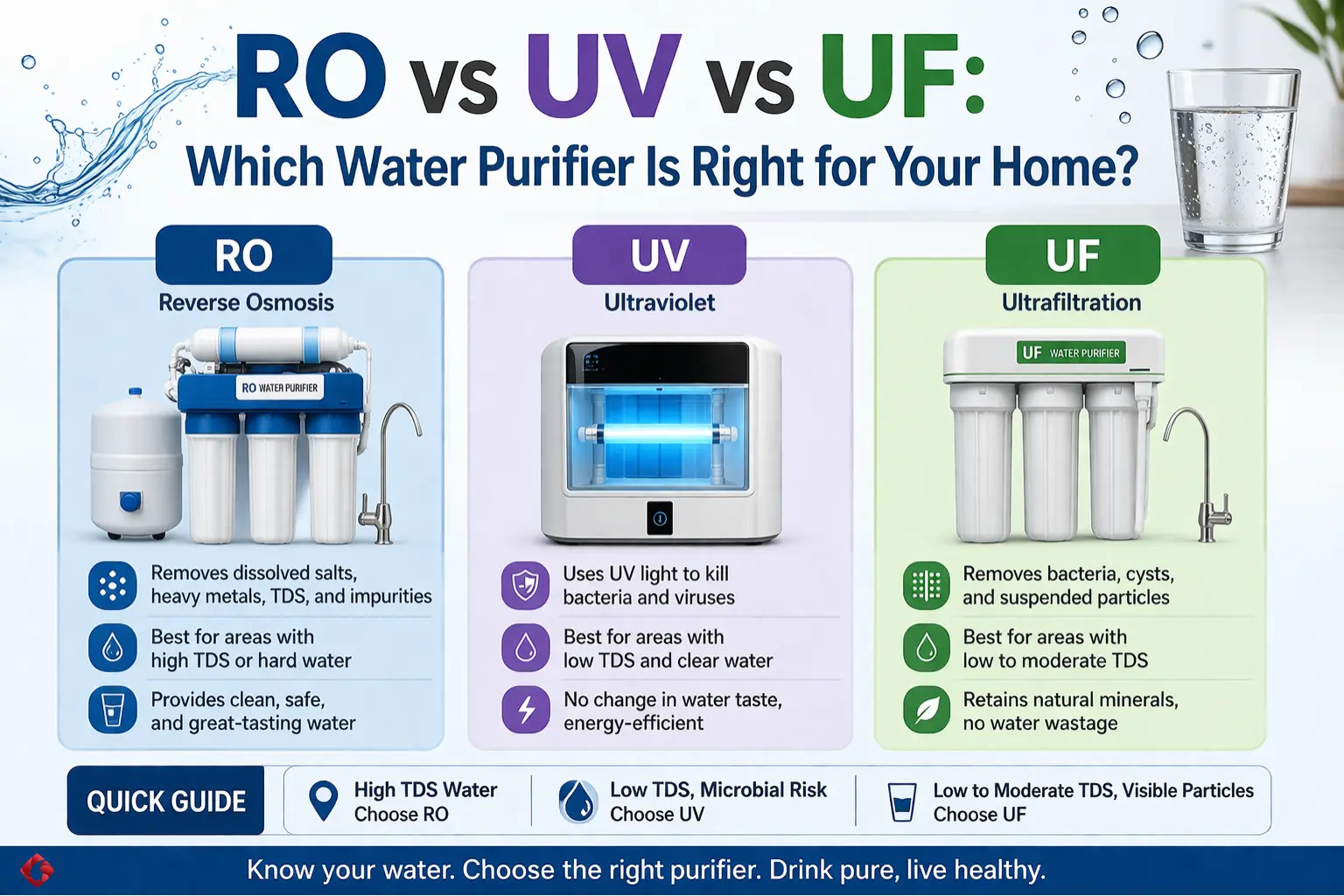
Clean drinking water is not a luxury; it is a daily necessity for every household. Yet many families still struggle to choose the right purification system because the market is crowded with technical terms, confusing claims, and products that look similar but perform very differently. The most common comparison that homeowners face is RO vs UV vs UF. Each purification method serves a distinct purpose, and the right choice depends on the quality of your incoming water, your family’s health priorities, and your long-term maintenance expectations.
At Bhola Ro Service, we help households make the right decision with practical guidance, professional installation, dependable maintenance, and honest support. Whether you are planning to buy your first purifier, replace an old machine, or upgrade to a smarter system, choosing correctly now can save money, improve taste, and protect your family’s health for years.
If you are searching for a trusted Water purifier shop in ghaziabad, this guide will help you understand exactly what to buy and why.
Understanding Why Water Purification Matters at Home
Tap water may appear clear, but visual clarity is not a reliable indicator of safety. Water can contain dissolved salts, heavy metals, chlorine, pesticides, bacteria, viruses, and suspended impurities without changing its appearance. In many urban and semi-urban areas, the water source can vary from municipal supply to borewell, tanker, or a mixed supply line. This means the quality of water entering your home may fluctuate from one season to another.
During summer, borewell water often carries higher TDS (Total Dissolved Solids). During monsoon, microbial contamination risk increases. In old pipelines, rust and sediments are common. In such conditions, selecting the wrong purifier is not a minor mistake—it can reduce filtration efficiency and compromise water safety.
This is why understanding the difference between RO, UV, and UF purification is essential before purchasing any unit.
What Is RO Water Purification?
RO (Reverse Osmosis) Explained Simply
RO, or Reverse Osmosis, is one of the most advanced and widely used water purification technologies. It works by forcing water through a semi-permeable membrane that removes extremely fine dissolved impurities.
An RO purifier is especially effective at removing:
- High TDS
- Dissolved salts
- Heavy metals like lead and arsenic
- Fluoride
- Nitrates
- Chemical contaminants
- Some microbes when paired with other filters
This makes RO highly suitable for homes where the water source is borewell water, hard water, or any source with high mineral load.
Best Use Case for RO
RO is ideal when:
- Water tastes salty or bitter
- Water leaves white stains on utensils or taps
- You use borewell or underground water
- TDS level is high
Benefits of RO Water Purifier
- Delivers cleaner, lighter-tasting water
- Removes harmful dissolved contaminants
- Suitable for hard and unsafe water sources
- Often comes with multi-stage purification
Limitations of RO
- Wastes some water during purification
- Requires regular membrane and filter maintenance
- Not always necessary for already low-TDS municipal water
If your home receives high-TDS water, an RO system is not just useful—it is often the most effective choice.
What Is UV Water Purification?
UV (Ultraviolet) Purification and How It Works
UV purification uses ultraviolet light to kill or deactivate harmful microorganisms such as:
- Bacteria
- Viruses
- Pathogens
This technology does not physically remove dissolved salts or sediments. Instead, it disinfects the water by targeting the DNA of microorganisms, preventing them from reproducing and causing illness.
Best Use Case for UV
UV is ideal when:
- Your water supply is already low in TDS
- Water looks clear
- Main concern is microbial contamination
- You receive treated municipal supply
Benefits of UV Water Purifier
- Effective against microorganisms
- Fast purification process
- No change in taste due to mineral retention
- Lower water wastage compared to RO
Limitations of UV
- Does not remove dissolved salts
- Does not remove heavy metals
- Does not remove muddy or suspended particles
- Requires clear water for UV rays to work efficiently
UV is best suited for households where the incoming water is chemically acceptable but may still need biological disinfection.
What Is UF Water Purification?
UF (Ultrafiltration) Technology Explained
UF, or Ultrafiltration, uses a membrane similar in concept to RO but with larger pores. It removes:
- Suspended solids
- Dust and sediments
- Some bacteria and cysts
- Visible impurities
Unlike RO, UF does not remove dissolved salts or significantly reduce TDS. It is often used in gravity-based or low-pressure purification systems.
Best Use Case for UF
UF is ideal when:
- Water has visible particles or turbidity
- Water pressure is low
- You want non-electric purification in some cases
- You need pre-filtration or basic filtration
Benefits of UF Water Purifier
- Works even with low pressure
- Good for removing physical impurities
- Usually easier to maintain
- Can be part of combination purifiers
Limitations of UF
- Does not reduce TDS
- Does not remove dissolved chemicals
- Less effective alone for uncertain water quality
UF is useful, but in most modern households it performs best when paired with other technologies rather than used alone.
RO vs UV vs UF: Side-by-Side Comparison
Which Technology Removes What?
Here is the simplest way to compare them:
RO Removes
- Dissolved salts
- Heavy metals
- Chemicals
- Hardness
- High TDS
UV Removes
- Bacteria
- Viruses
- Microbial contamination
UF Removes
- Dust
- Sediments
- Suspended particles
- Some microorganisms
This means no single technology is “best” for every home. The correct purifier depends on your water source and water quality report.
How to Choose the Right Water Purifier for Your Home
Step 1: Check Your Water Source
Before buying any purifier, identify your primary water source:
- Municipal Supply
- Borewell Water
- Tanker Water
- Mixed Supply
This matters because each source has different contamination risks.
Municipal Water
Usually lower in TDS but may contain:
- Chlorine
- Pipe contamination
- Bacteria due to leakage
A UV or UV+UF purifier may work well if TDS is low.
Borewell Water
Usually higher in:
- TDS
- Hardness
- Fluoride
- Dissolved salts
A RO-based purifier is generally the right choice.
Tanker Water
Quality can vary widely. It may carry:
- Sediments
- Mixed chemical contamination
- Microbial risk
A RO+UV+UF purifier is often the safest option.
Step 2: Measure TDS Level
TDS is one of the most important indicators when selecting a purifier.
Recommended Guide
- Below 150 ppm: Basic filtration or UV/UF may be sufficient
- 150–300 ppm: Depends on source and contamination
- Above 300 ppm: RO is usually recommended
- Above 500 ppm: Strongly consider RO with multi-stage purification
If your water tastes salty, metallic, or unusually heavy, high TDS may already be affecting your daily consumption.
Step 3: Understand Your Family’s Needs
Every household is different. Ask:
- Do you have children or elderly family members?
- Is your family sensitive to stomach infections?
- Do you want better taste in drinking water?
- Is your current purifier frequently breaking down?
- Do you need a unit for daily high usage?
For most families today, a multi-stage purifier with a smart combination of technologies is the most practical and future-ready option.
Which Purifier Is Best for Most Homes Today?
Why Combination Purifiers Are Often the Smartest Choice
Modern homes increasingly prefer RO+UV+UF systems because they address multiple risks at once.
A combination purifier can:
- Remove dissolved impurities
- Kill microorganisms
- Filter visible sediments
- Improve taste and clarity
This is especially useful in locations where the water source changes across seasons or where households receive mixed water from municipality, borewell, and tankers.
For families that do not want to take chances with water quality, a combination system offers the most complete protection.
Why Buying from the Right Seller Matters as Much as the Purifier
A purifier is not just a product; it is a long-term home appliance that needs correct installation, timely servicing, genuine spare parts, and expert guidance. Many buyers make the mistake of purchasing a machine based only on price or online listings, only to face poor after-sales support later.
That is where Bhola Ro Service stands apart.
Why Homeowners Prefer Bhola Ro Service
At Bhola Ro Service, we focus not only on selling water purifiers but on ensuring every customer gets the right purifier for the right water condition.
What Makes Bhola Ro Service a Preferred Choice
- Professional guidance for RO, UV, and UF selection
- Reliable installation and setup
- Support for home and office purifier systems
- Genuine spare parts and quality servicing
- Prompt maintenance and repair assistance
- Transparent recommendations based on actual water needs
For households looking for dependable RO Service in Ghaziabad, choosing a team that understands local water conditions can make a significant difference in purifier performance and lifespan.
Common Mistakes People Make When Buying a Water Purifier
Avoid These Costly Errors
1. Buying Without Testing Water
Many families buy an RO purifier even when they only need UV, or buy UV when their water clearly needs RO.
2. Choosing Based on Brand Alone
A popular brand does not automatically mean the purifier is suitable for your water source.
3. Ignoring Maintenance
Filters, membranes, and UV lamps require periodic attention. Ignoring servicing reduces purification efficiency.
4. Buying Cheap Non-Genuine Parts
Low-quality parts can affect water purity and damage the purifier.
5. Not Considering Daily Capacity
A small storage unit may not meet the needs of a larger family.
A proper consultation before buying often prevents all these problems.
Maintenance Tips to Keep Your Water Purifier Performing Well
Even the best purifier needs routine care. To maintain healthy water quality:
Basic Water Purifier Care Checklist
- Replace filters on schedule
- Service the purifier periodically
- Clean the storage tank
- Check TDS output when needed
- Inspect leakage or unusual sound
- Use genuine parts for replacement
A well-maintained purifier lasts longer, performs better, and keeps your drinking water consistently safe.
RO vs UV vs UF: Final Recommendation for Homeowners
If you are still deciding, here is the simplest answer:
Choose RO If
- Your water has high TDS
- You use borewell or hard water
- You want removal of dissolved impurities
Choose UV If
- Your water has low TDS
- Your main concern is germs and microbes
- You receive relatively clear municipal water
Choose UF If
- You need removal of suspended particles
- You have low-pressure water
- You want support filtration
Choose RO+UV+UF If
- You want all-round protection
- Your water source changes often
- You want a more reliable long-term household solution
For most modern homes, especially where water quality is inconsistent, RO+UV+UF is often the most practical and protective option.
Conclusion: Choose Smart, Drink Safe, Live Better
Choosing between RO, UV, and UF should never be a guessing game. The right purifier depends on the actual quality of water entering your home. A system that works perfectly in one house may be ineffective in another. That is why informed selection matters more than marketing promises.
For homes dealing with hard water, high TDS, mixed supply, uncertain quality, or changing seasonal conditions, a professionally recommended purifier is the safest path forward. With the right machine and the right support, your family gets cleaner water, better taste, improved confidence, and long-term peace of mind.
At Bhola Ro Service, we believe every home deserves safe, dependable drinking water backed by trusted service and practical expertise. If you are planning to buy, upgrade, repair, or maintain a purifier, making the right choice today can protect your household every single day.
Safe water begins with the right purifier—and the right people behind it.
Frequently Asked Questions (FAQs)
Yes, an RO water purifier is highly suitable for home use, especially where water has high TDS, hardness, dissolved salts, or chemical contamination.
If your water tastes salty, leaves stains, or comes from a borewell or mixed source, you likely need RO. A TDS check gives the clearest answer.
RO removes dissolved impurities and high TDS, while UV kills bacteria and viruses. RO changes water composition; UV disinfects it.
- UV may be enough if your water already has low TDS and low chemical contamination and your only concern is microbial safety.
No, UF does not significantly reduce TDS. It mainly removes suspended particles and some microorganisms.
An RO-based purifier, preferably RO+UV+UF, is usually the best choice for borewell water due to high TDS and dissolved contaminants.
Yes, when properly maintained and installed according to water quality needs, RO purified water is safe for families, including children and senior citizens.
Regular servicing depends on water quality and usage, but filters and internal components should be checked periodically to maintain safe purification.
A multi-stage purifier can handle a wider range of water conditions, but the best system still depends on your source water quality.
For expert advice, installation, maintenance, and dependable support, Bhola Ro Service remains a trusted choice for households seeking long-term purifier reliability.