
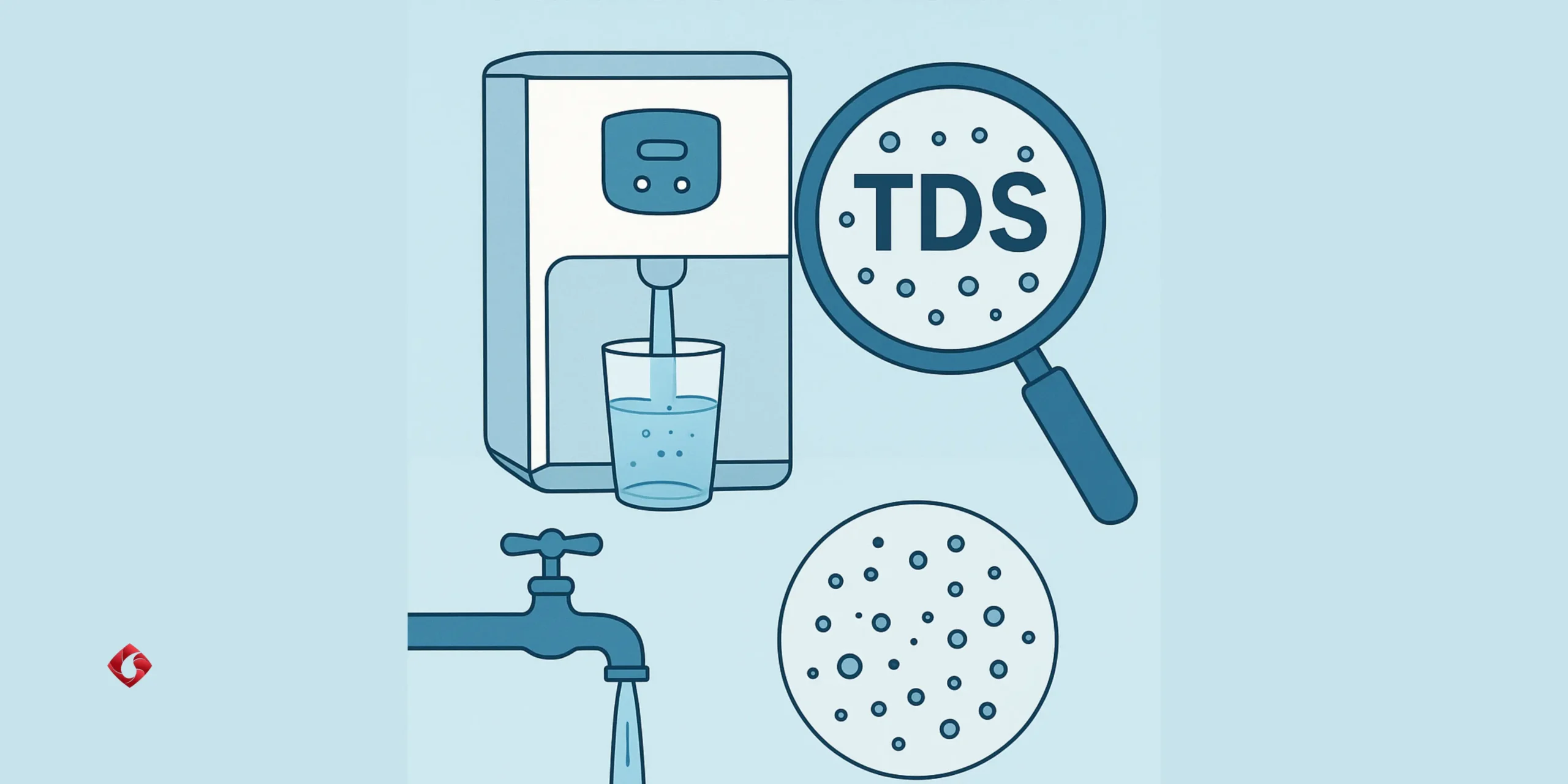
If you use an RO water purifier at home, you’ve probably heard the term TDS many times. But what exactly does TDS mean? And why is it so important for choosing the right water purifier and maintaining its performance?
In this article, we break it down in simple, practical language.
What is TDS?
TDS stands for Total Dissolved Solids.
It refers to the total amount of organic and inorganic substances dissolved in water, including:
- Minerals
- Salts
- Metals
- Ions
- Chemicals
TDS is measured in ppm (parts per million) or mg/L.
What contributes to TDS in water?
Common sources include:
- Natural minerals (calcium, magnesium, potassium)
- Industrial waste or chemicals
- Agricultural runoff (fertilizers, pesticides)
- Rust and metal pipes
- Sewage contamination
Not all TDS is harmful. Some minerals in water are actually good for health — but too much can be dangerous.
Ideal TDS Level for Drinking Water
TDS Level (ppm) | Water Quality |
0–50 | Very low mineral content |
50–150 | Excellent for drinking |
150–300 | Good |
300–500 | Acceptable |
500–900 | Poor – needs purification |
900+ | Unsafe – not recommended |
According to WHO & BIS standards, the acceptable TDS for drinking water is up to 500 ppm.
How Does TDS Affect Your RO Water Purifier?
1. Determines whether you need RO purification
RO (Reverse Osmosis) purifiers are mainly used when TDS is above 250–300 ppm.
- If TDS is low, RO may remove too many essential minerals.
- If TDS is high, RO is necessary to remove harmful salts, metals, and contaminants.
2. Affects filter lifespan
Higher TDS leads to:
- Faster clogging of sediment & carbon filters
- More pressure on RO membrane
- Reduced overall purifier lifespan
This means more frequent filter replacements.
3. Impacts taste and odor
Water with high TDS may:
- Taste salty
- Taste bitter
- Have an unusual smell
- Leave white scaling on utensils
Your RO purifier corrects this, but with very high TDS, the purifier may struggle.
4. Affects purifier performance & output
High TDS impacts:
- Purification efficiency
- Water flow rate
- Wastewater ratio
- Purity of final drinking water
Water with extremely high TDS (>1000 ppm) may require pre-treatment or additional purification stages.
Symptoms of High TDS in Water
You may be dealing with high TDS if you notice:
- White scaling on taps, kettles, or utensils
- Bad taste or smell in water
- Skin dryness after bathing
- Reduced soap lather (hard water)
- Early failure of home appliances like geysers and washing machines
In such cases, an RO purifier becomes essential.
How to Check TDS at Home
You can measure TDS using:
- Digital TDS Meter (fast & accurate)
- Water test kits
- Professional water testing services
For best purifier performance, check TDS every 3–6 months.
How RO Purifiers Control TDS
Reverse Osmosis works by pushing water through
How RO Purifiers Control TDS
Reverse Osmosis purifiers work by pushing water through a semi-permeable membrane.
This membrane blocks:
- Excess salts
- Heavy metals
- Harmful chemicals
- Microorganisms
- Dissolved impurities
Only pure water molecules pass through, reducing TDS to safe levels.
Most modern RO purifiers also include:
- Sediment Filter – removes dust, dirt, and sand
- Carbon Filter – removes chlorine, smell, and organic impurities
- RO Membrane – reduces high TDS
- UF / UV Stages – adds extra purification
- TDS Controller / Mineralizer – restores essential minerals
This combination maintains taste while keeping water safe.
Why TDS Controller or Mineralizer is Important
When RO filtration reduces TDS too much (below 70 ppm), the water may lose essential minerals like calcium & magnesium.
That’s why many purifiers come with:
1. TDS Controller
It mixes a small amount of raw water (after pre-filters) with RO-filtered water.
This keeps mineral balance stable.
2. Mineralizer / Alkaline Filter
It adds back beneficial minerals to improve taste and pH level.
These are essential if your water source is borewell or has naturally low TDS.
What Happens if TDS is Too Low?
Very low TDS (<50 ppm) may result in:
- Flat or tasteless water
- Lack of essential minerals
- Possible long-term health impact (mineral deficiency)
If your raw water TDS is already low, consider:
- UV + UF purifier instead of RO
- Using RO with a strong mineralizer
How TDS Affects Your Health
High TDS water may cause:
- Indigestion
- Kidney stones
- High salt intake
- Metallic taste
- Heart-related risks (due to sodium)
Low TDS water may cause:
- Mineral deficiency
- Weak taste
- Poor hydration efficiency
Maintaining the right balance is key.
Best TDS Range for RO Purifier Output
After purification, the ideal TDS should be:
- Between 75–150 ppm for drinking
- Up to 200 ppm if you prefer slightly mineral-rich water
Anything below 50 ppm is too low, and above 300 ppm may not be ideal.
When You Should Get Professional TDS Testing
You should get a technician to inspect your water if:
- Water tastes salty or bitter
- Filters are clogging too fast
- RO output has reduced
- Water flow is slow
- White scaling is visible on utensils
- TDS levels fluctuate frequently
Regular 6-month maintenance ensures your purifier works efficiently.
Tips to Maintain Ideal TDS Levels at Home
- Check TDS every 2–3 months
- Replace filters on time
- Clean and sanitize the RO storage tank
- Use a pre-filter for borewell water
- Never skip annual RO membrane inspection
- Install a mineralizer if water tastes too low-TDS
Good maintenance ensures healthier, better-tasting water.
Conclusion
TDS plays a crucial role in your water quality and the performance of your RO purifier.
Understanding TDS helps you:
- Choose the right water purifier
- Maintain your purifier properly
- Ensure safe and healthy drinking water
- Avoid unnecessary repairs
If your water has high or fluctuating TDS, getting professional servicing is the best way to keep your purifier working efficiently.
FAQs — TDS & Water Purifiers
TDS stands for Total Dissolved Solids, which includes minerals, salts, metals, and organic matter dissolved in water. It indicates overall water purity.
The ideal TDS level for drinking water is 50–150 ppm, while anything up to 500 ppm is considered acceptable as per BIS standards.
Yes. High TDS (above 500 ppm) may cause salty taste, scaling, digestive problems, kidney issues, and may contain harmful metals or chemicals.
- Extremely low TDS (<50 ppm) may lack essential minerals like calcium and magnesium, affecting taste and long-term mineral balance in the body.
Yes. RO purifiers are designed to reduce high TDS levels by filtering out dissolved salts, metals, and impurities using a semi-permeable membrane.
You should use an RO purifier when your source water TDS is above 250–300 ppm or contains heavy metals, chemicals, or impurities.
Yes. RO systems may reduce TDS to very low levels. If the output is below 50 ppm, you may need a TDS controller or mineralizer to restore minerals.
You can check TDS using a digital TDS meter, water test kit, or by asking a professional technician to measure it during servicing.
This may happen due to issues like a damaged RO membrane, blocked filters, faulty TDS controller, or high TDS in input water. Servicing is recommended.
TDS should be checked every 2–3 months, or sooner if water taste changes, flow reduces, or filters clog frequently.
A TDS controller adjusts the mineral level in purified water by mixing a controlled amount of pre-filtered water with RO-filtered water.
TDS measures all dissolved solids, while hardness only measures calcium and magnesium levels. Hard water may still have low TDS and vice versa.
Yes. Very high TDS (>1000 ppm) puts extra pressure on the RO membrane, shortens filter life, and increases maintenance frequency.
RO is the most effective system for high TDS. However, water with extremely high TDS may need pre-filters or softeners before entering the RO.
No. Boiling kills bacteria but does not reduce TDS. In fact, it can slightly increase concentration as water evaporates.